The house at the end of Birch Road had been empty for six years. Everybody knew that.
The paint was coming off the walls. The garden was full of tall grass. One window on the second floor was broken, and someone had covered it with a piece of wood. The children on Birch Road called it the Ghost House, and they ran a little faster when they walked past it.
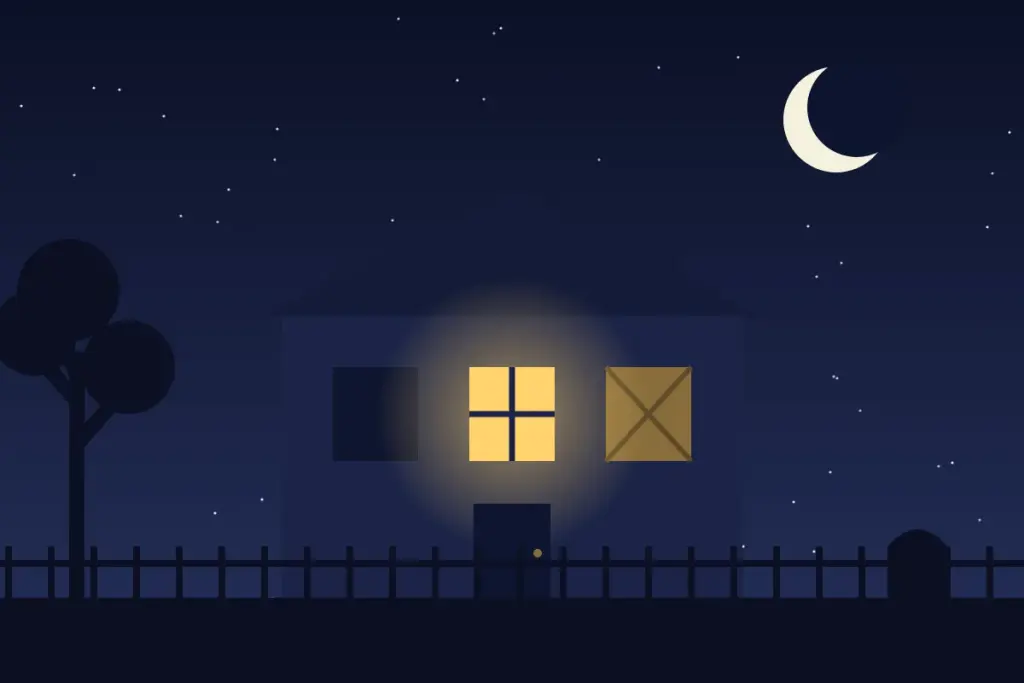
So when Nora saw a light in the window at two o’clock in the morning, she sat straight up in bed.
She was twelve years old. She had woken up for a glass of water, and from her bedroom window, she could see the whole end of the road. And there it was. A small, yellow light, moving slowly from one room of the empty house to another.
Then it went out.
Nora stayed at the window for an hour. Nothing else happened. In the morning, she almost believed she had dreamed it.
The next night, she set her alarm for two o’clock.
The light came again.
* * *
“There is someone in the Ghost House,” Nora said at breakfast.
Her mother did not look up from her phone. “Don’t call it that. And no, there isn’t. It’s been empty since Mrs. Lane moved to the care home.”
“I saw a light. Two nights in a row.”
“Probably the moon on the glass,” said her father.
Only one person at the table did not laugh. Her grandfather, who had lived with them since last winter, put down his tea. He had been a police officer for thirty-five years, and he still had the habit of listening very carefully.
“What time?” he asked.
“Two o’clock. Both times. It moves from the kitchen to the room at the back. Then it goes out at about two-thirty.”
Grandpa was quiet for a moment. “Every night at the same time,” he said. “That’s not a ghost, Nora. Ghosts don’t keep a schedule.” He winked. “People do.”
* * *
That afternoon, Grandpa and Nora went for a walk. A very slow walk. A walk that went all the way to the end of Birch Road and stopped in front of the empty house.
“Look carefully,” Grandpa said. “Tell me what you see.”
Nora looked. At first she saw only the old house. Then she began to notice things.
“The grass by the back door is flat,” she said. “Like someone walks there.”
“Good. What else?”
“The lock on the gate is new. It’s shiny. Everything else is old and rusty.”
“Very good.” Grandpa pointed with his walking stick. “And the gutter. Look at the gutter.”
Nora looked up. Part of the long metal gutter on the roof was brown and broken. But one section, above the back door, was new and clean.
“Someone is fixing it,” Nora said slowly. “Someone is fixing the house. But only at night. Why would anyone do that?”
Grandpa did not answer. But he was looking at the house with a strange, thoughtful face.
* * *
That night, Grandpa did something Nora never expected. He knocked on her door at 1:45.
“Put on your warm jacket,” he whispered. “And your quiet shoes.”
They walked down Birch Road in the dark. The street was silent. A cat ran across in front of them, and Nora’s heart almost stopped. Grandpa held her hand, and his hand was calm and steady.
They stopped behind a tree near the empty house and waited.
At exactly two o’clock, a car parked down the street, with its lights off. A man got out. He was tall, maybe forty years old, with a bag of tools in one hand and a flashlight in the other. He opened the new lock on the gate and went around to the back door.
A moment later, the yellow light came on in the kitchen.
“Grandpa,” Nora whispered. “Should we call the police?”
“I am the police,” Grandpa whispered back with a little smile. “Well. I used to be. Stay close to me.”
* * *
The back door was open. Grandpa knocked on it gently.
“Good evening,” he said. “Please don’t be afraid. We’re neighbors.”
The man spun around. He dropped his hammer. In the light of the flashlight, his face was full of fear, and then full of something else. Shame.
“I’m not stealing,” he said quickly. “Please. I’m not stealing anything. This is my mother’s house.”
Nora looked around the kitchen. It was not what she expected at all. The floor was clean. The walls were freshly painted a soft yellow. On the table were cans of paint, new light bulbs, and a stack of old photos.
“You’re Mrs. Lane’s son,” Grandpa said. It was not a question.
The man nodded slowly. “My name is Peter. I haven’t… I haven’t seen my mother in eight years.”
He sat down on a box of tiles. And there, in the middle of the night, in the empty house, he told them everything.
* * *
Eight years ago, Peter and his mother had a terrible argument. It was about money, about a business he wanted to start, about words that should never have been said. He was angry and proud. He left the city and did not call. She was hurt and proud. She did not call either.
“Every year I told myself, next year I’ll call her,” Peter said. “And every year it got harder. The longer you wait, the bigger the silence becomes. In the end it was like a wall.”
Then, three months ago, a cousin told him that his mother had fallen, that she was in a care home now, and that the house was empty and falling apart.
“She loved this house,” Peter said. His voice broke. “My father built the back room with his own hands. She raised me here. And I let it fall apart, the same way I let us fall apart.”
“So you’re fixing it,” Nora said softly.
“I work all day in another town. I drive here at night, two hours each way. I wanted to fix everything. Make it beautiful again. And then, when it was ready…” He stopped.
“Then you’d go and see her,” Grandpa said gently.
Peter nodded. “I thought if I came with a beautiful house, maybe she would forgive me. I can’t go with empty hands. Not after eight years.”
The longer you wait, the bigger the silence becomes.
Grandpa was quiet for a long time. Then he put his hand on Peter’s shoulder.
“Son,” he said, “I’m an old man. Let me tell you something old men know. Your mother does not want a painted kitchen. She wants her son. And nobody knows how much time they have left.”
* * *
The next Saturday, Nora and her grandfather drove Peter to the care home. He was so nervous that his hands were shaking. He held a small bunch of yellow flowers, the same color as the new kitchen walls.
Mrs. Lane was sitting by the window in a wheelchair, with a blanket over her knees. She was thinner than Nora remembered.
Peter stood in the doorway. He could not move.
Then Mrs. Lane turned her head. She looked at him for a long, long moment. Her lips began to shake.
“Peter?” she whispered.
“Hello, Mom,” he said. “I’m sorry. I’m so sorry. I should have…”
But she was already holding out her arms. And Peter, a grown man of forty, crossed the room and knelt beside her chair and put his head on her knees like a little boy, and she put her hands on his hair, and neither of them said anything at all.
Nora had to look away. Grandpa gave her his handkerchief. She noticed that his eyes were wet too.
* * *
Three months later, the house at the end of Birch Road had fresh white paint and a garden full of flowers. The broken window was fixed. And the lights were on every evening, not at two in the morning, but at a normal time, like any other house.
Mrs. Lane was home. Her leg was stronger now. Peter had moved back to the city to take care of her.
Sometimes, in the afternoon, Nora went over to drink lemonade on the porch with them. Mrs. Lane liked to show her the old photos and tell stories about the house.
“You know,” Mrs. Lane told her one day, “the children used to call this the Ghost House.”
Nora felt her face go red. “I know. I’m sorry.”
Mrs. Lane laughed. “Don’t be sorry. They were right, in a way. For six years, this house was full of ghosts. Old arguments. Old pride. Words we never said.” She looked at her son, who was fixing the garden fence. “But you can’t fix a house in the dark, sweetheart. Some things need the light.”
Pride builds walls that grow taller every year we wait. Peter thought he needed something perfect to bring. In the end, all his mother ever needed was him at the door.