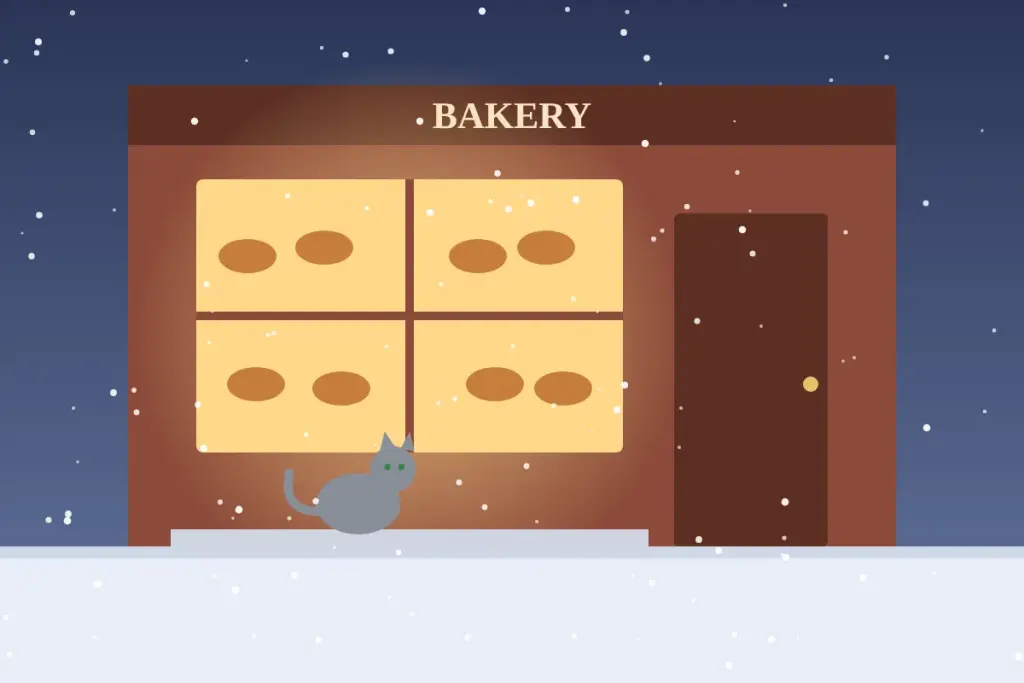
Every winter, on the first cold morning, a grey cat sat outside the window of Hassan’s Bakery.
She was not a pretty cat. One of her ears had a small piece missing, and her tail was bent at the end, like a question mark. But she had big green eyes, and she always sat in the same place: on the step, right next to the warm glass, where the heat from the ovens came through.
Old Hassan saw her the first winter and gave her a piece of bread with butter. She ate it slowly, looked at him, and walked away. The next morning, she was back.
“She has good taste,” Hassan said to his grandson, Karim. “She knows the best bread in the city.”
Karim was eight that year. He named her Smoke, because she was grey and because she disappeared like smoke every spring. When the weather got warm, she was simply gone. Nobody knew where she went. And every winter, on the first cold morning, she came back.
* * *
For six winters, it was the same. Smoke arrived with the first frost. She sat on the step. Hassan gave her bread and butter, and later, when the doctor told him to eat less butter himself, a small dish of milk and chicken. Customers started to ask about her. Children came to the bakery just to see her.
“She is good for business,” Hassan laughed. “Maybe I should pay her.”
Karim grew up. At fourteen, he started helping in the bakery after school. He learned to knead the dough and shape the bread and pull the hot trays from the oven without burning his fingers. And every winter, he was the first one to see Smoke come back.
Then, the year Karim turned fifteen, Grandpa Hassan got sick.
It started with a cough that did not go away. Then he was tired all the time. Then one morning in October, he could not get out of bed. The doctors said his heart was weak. He needed to rest. He could not work in the hot bakery anymore.
“Who will open the bakery?” Hassan asked from his bed. “Who will make the bread?”
“I will,” Karim said.
His grandfather looked at him for a long time. “You are fifteen.”
“I’ve been watching you since I was eight,” Karim said. “I know how.”
* * *
It was very hard. Karim woke up at four every morning. He made the dough the way his grandfather taught him. He went to school, tired, and came back to clean the trays and prepare for the next day. His mother helped at the counter. Some days the bread was perfect. Some days it was too dark, or too flat, and customers complained.
And every day, Karim walked home past the hospital and stopped to tell his grandfather everything.
“The bread was too salty today,” he said one evening. “Mrs. Nadia told me.”
Hassan smiled weakly. “Mrs. Nadia has told me my bread was too salty every week for thirty years. It means she likes you.”
But Karim could see that his grandfather was getting weaker. He slept more. He ate less. He did not laugh as much.
One evening in late November, Hassan held his grandson’s hand and asked a strange question.
“Has it been cold yet? Really cold?”
“Not yet, Grandpa. It’s been a warm autumn.”
The old man closed his eyes. “When the first frost comes, look for her,” he said. “Smoke. Make sure somebody feeds her. Promise me.”
“I promise,” Karim said. His voice was not steady.
* * *
The first frost came on the eighth of December.
Karim opened the bakery at five in the morning. The street was white and silent. His breath made clouds in the air. He turned on the lights, started the ovens, and looked out the window.
The step was empty.
He waited. Six o’clock. Seven o’clock. Customers came and went. The step stayed empty.
“Maybe she’s late,” his mother said gently.
“She’s never late,” Karim said. “Not in seven years.”
All day, he kept looking at the window. He told himself it was just a cat. He told himself cats get old, or find new homes. But it felt like something more. It felt like a sign, and he was afraid of what it meant.
That evening, he did not want to go to the hospital. He did not want to tell his grandfather that Smoke had not come.
* * *
The next morning was even colder. Karim walked to the bakery in the dark, his hands deep in his pockets. He turned the corner and stopped.
There, on the step, was Smoke.
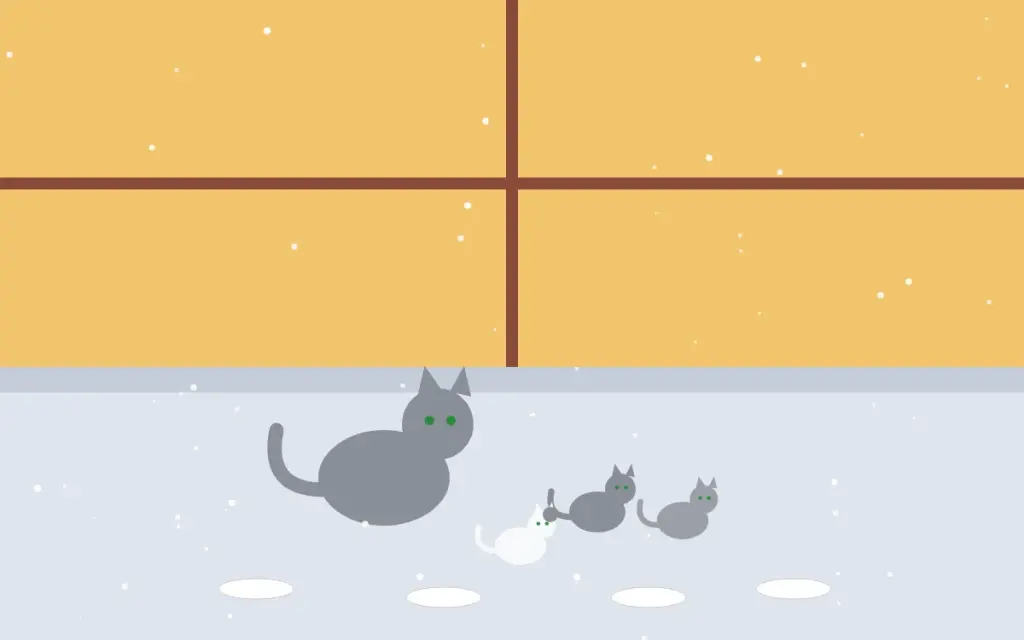
But she was not alone. Pressed against her side, in the warm place by the glass, were three tiny kittens. Two were grey like her. One was white with a grey spot on its head, exactly where Smoke had her broken ear.
Smoke looked up at him with her big green eyes, as if to say: Sorry I’m late. I was busy.
Karim laughed out loud in the empty street. Then he ran inside, warmed some milk, and put it on the step in four small dishes.
Sorry I’m late. I was busy.
He took a picture with his phone. His hands were shaking a little.
* * *
That evening, he showed the picture to his grandfather.
Hassan looked at it for a long time. Then his face changed. For the first time in weeks, he smiled the old smile, the one that made his eyes almost disappear.
“She came back,” he whispered. “And she brought her family.” He gave the phone back to Karim. “You see? Life always finds a way to continue. Even when we are afraid it won’t.”
Something changed after that. Maybe it was the picture. Maybe it was the medicine. Maybe it was just time. But Grandpa Hassan began to eat more. He sat up in bed. He started giving Karim instructions about the bread again, which the doctors said was a very good sign.
In February, he came home.
In March, on a sunny morning, he walked slowly into the bakery with his walking stick, sat on a chair by the window, and tasted a piece of bread his grandson had made.
He chewed for a long time. Karim held his breath.
“A little too salty,” Hassan said. Then he winked. “Perfect.”
Smoke and her kittens disappeared in the spring, as always. But the white kitten with the grey spot never left. She lives in the bakery now. Karim named her Butter. She sleeps by the oven, and every morning she sits on the step next to the warm glass, waiting for the first customer.
And every winter, on the first cold morning, Smoke still comes back to visit.
Small promises matter. A boy kept his word to feed a cat, and in return, the cat brought back something his whole family needed: hope.